Earlier, SEO meant to rank higher on Google. Businesses invested in keyword optimization, backlinks, and meta tags, and success was measured by where you appeared in a list of ten blue links. That world still exists, but it’s not the complete story.
SEO in 2026 is changing faster. AI search engines such as ChatGPT, Google SGE, Perplexity, and Claude are now changing the way how people find information online. Instead of typing a keyword and scanning results, users are asking questions and receiving direct answers by AI.
This has made the gap between AI SEO vs traditional SEO more important for businesses to understand. And that’s what this blog is all about!
Let’s together understand what AI SEO is, how it differs from traditional SEO, why the difference matters, and the modern SEO strategies for 2026.
Here we start!
What is Traditional SEO?
Simply, traditional SEO is the practice of optimizing a website to rank higher in Google’s organic search results. For two decades, it has been the key of digital marketing for businesses of all sizes.
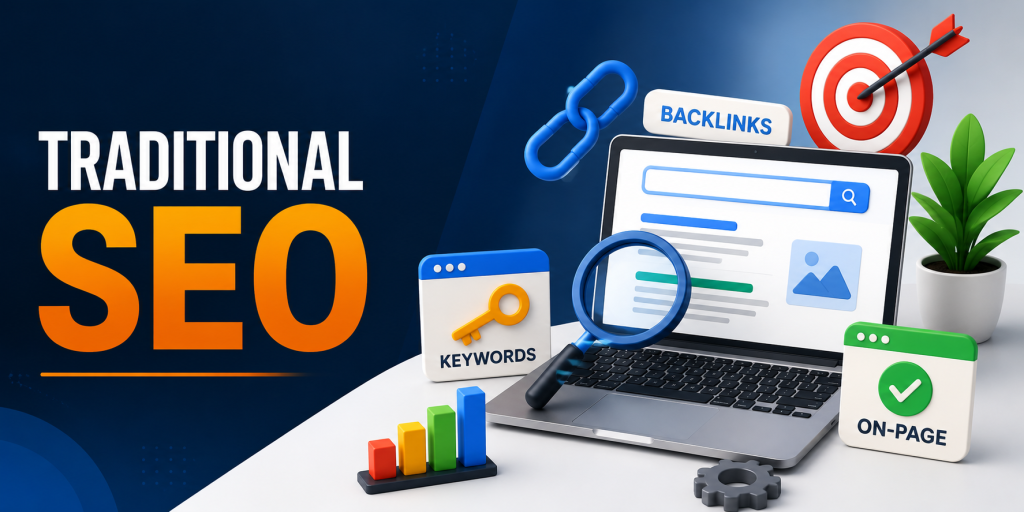
It basically revolves around keyword optimization. It means researching what people type into search engines and adding those terms into page content, headings, URLs, and meta tags to signal relevance to Google for specific queries.
Other than that, backlinks are the main authority signal. It tells Google that your content is trusted and worth ranking. Traditional SEO is built around SERP-focused strategies and also success is measured by Google rankings.
What is AI SEO?
AI SEO is the latest form of search optimization for a world where AI engines are answering user queries directly. It makes content understandable, authoritative, and citable by the AI systems that generate direct answers to user questions.
GEO, or Generative Engine Optimization, is at the core of AI SEO which helps structuring content in such a way that it gets selected and cited in AI-generated search responses. Closely linked to this is AEO (Answer Engine Optimization), which means optimizing content to answer the specific questions users are asking today.
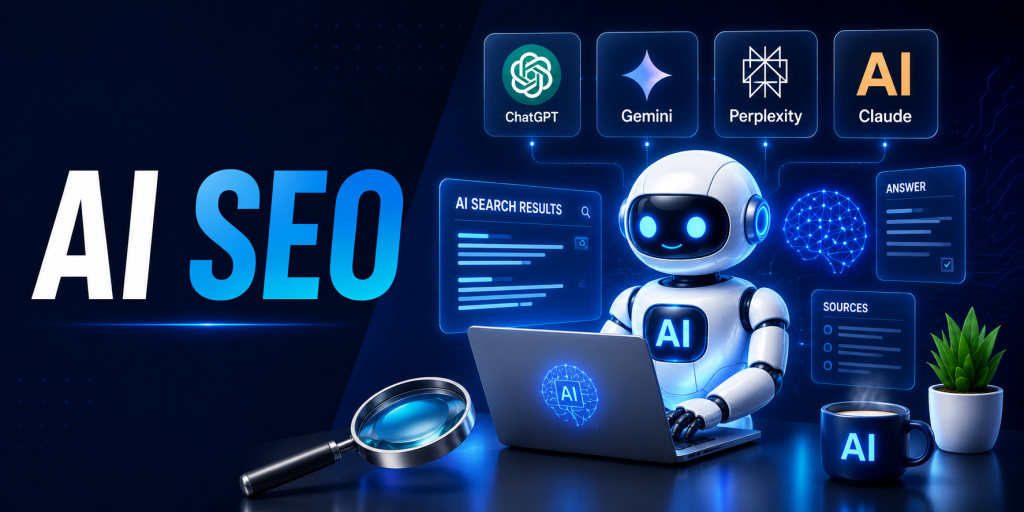
Some key AI platforms that are reshaping the search in 2026 are OpenAI (ChatGPT), Google SGE, Perplexity AI, and Anthropic (Claude). Today, ChatGPT SEO, Perplexity SEO, and Google SGE SEO are important for a complete AI search engine optimization.
AI SEO vs Traditional SEO: Key Differences
Now before we move ahead, let’s quickly look at the differences between AI SEO and traditional SEO.
| Factors | Traditional SEO | AI SEO |
| Primary Focus | Rankings in search results | Being cited in AI-generated answers |
| Content Approach | Keyword-heavy optimisation | Context and meaning-focused writing |
| Target Platform | Google search engine only | AI engines + traditional search |
| Visibility Format | Blue link results pages | AI-generated summaries and answers |
| Content Style | Page-optimized for crawlers | Conversational and question-based |
| Authority Signal | Backlink quantity and quality | Entity authority and topical depth |
| Success Metric | Ranking position | Citations, mentions, and answer inclusion |
| User Intent | Keyword matching | Natural language understanding |
Why Traditional SEO Alone is No Longer Enough
If you are thinking that traditional SEO is dead, well, you are wrong. You can say that it is no longer a standalone strategy. Here’s why:
- The Rise of AI Search
Today ,millions of people are using ChatGPT, Perplexity AI, and Google SGE to search information and these platforms don’t return a list of links. They return a single answer. If your business isn’t part of that answer, you are lacking behind.
- Zero-Click Searches
Google searches now end without a click because Google answers the question directly in the results through featured snippets, knowledge panels, and AI-generated summaries. For these queries, you need to be the source an AI engine selects to extract and present your website.
- AI-Generated Answers
When a user receives a direct answer from an AI engine, they often don’t visit a website at all. This means that ranking for a keyword no longer guarantees the visibility or traffic it once reliably delivered.
- Voice Search Growth
Voice search queries are conversational by nature. For example, “What is the best digital marketing strategy for small businesses in Jaipur?” Traditional content don’t match the natural language patterns of voice queries. Businesses that haven’t updated their content approach are already missing a growing share of voice-based searches.
- User Behavior Changes
Users are now comfortable asking AI tools questions and expecting direct answers. This is how people engage with data online, and SEO strategies that don’t take this into account will continue to lose out to those that do.
How AI SEO Works in 2026
Understanding how AI SEO works will help you do AI SEO effectively. These include:
- Entity SEO
In AI-powered search, entity SEO matters as much as keywords. Google’s Knowledge Graph and LLM models understand content as entities, and they evaluate the quality and authority of your content for people, places, businesses, and concepts that matter to your industry.
- Semantic Search
Semantic SEO means AI engines evaluate the meaning and context of content. You must create content that thoroughly covers a topic, addresses related concepts, and uses natural language as it performs better than content built around keywords.
- Structured Data
Structured data basically gives AI engines machine-readable information about your content. You must consider adding schema for FAQs, blogs, local businesses, products, and reviews. This helps Google understand what your content is all about and increases the chances to show up in AI-generated answers.
- FAQs & Direct Answer Formats
Content structured around clear questions and direct answers is the way to succeed in AI search era. Answer engine optimization relies on well-structured FAQ sections and question-based headings that mirror how users actually phrase their queries to AI tools.
- Author Authority & E-E-A-T
Google’s E-E-A-T framework, that is, Experience, Expertise, Authoritativeness, and Trustworthiness, has become even more important today. AI engines evaluate source credibility before citing content, which means building clear author authority can help you succeed.
- AI-Readable & Conversational Content
Well-structured, clearly written, and AI-friendly content that reads naturally and answers questions the way a knowledgeable expert would is more likely to be selected by AI engines as a citation source. Thus, you must write content that mirrors natural language query patterns.
Best AI SEO Strategies for 2026
Now, let’s check out the most impactful AI SEO strategies that businesses must plan to implement right now!
- Implement Schema Markup
Add structured data markup across your website, including FAQ schema, Article schema, LocalBusiness schema, Review schema, and BreadcrumbList schema. It gives AI engines machine-readable information about your content and improves the likelihood of appearing in rich results and AI-generated answers.
- Build Entity-Based Content
Create content that establishes your brand and services as well-defined. This includes a well-structured About page, consistent brand mentions, and content that thoroughly addresses the entities most relevant to your industry.
- Add FAQ Sections to Every Key Page
Every service page, blog post, and landing page should include a FAQ section addressing questions your audience is actually asking. Write answers in clear and direct language and implement FAQ schema markup so AI engines can easily extract and cite them. This is a main component of AEO SEO.
- Build Deep Topical Authority
You must build an in-depth coverage of the most relevant topics to your business. A cluster of thoroughly researched and well-linked content signals to both Google and AI engines that your website is a genuinely authoritative source. This makes it more likely to be cited in AI-generated summaries.
- Optimize for Conversational & Voice Search
Review your content and ask: does this read the way a knowledgeable person would answer this question? Also, include question-based headings throughout your content to match the format of voice queries. This is one of the most important AI search engine optimization strategies businesses can make immediately.
- Build Branded Mentions
Mentions of your brand name on news sites, industry publications, social platforms, and blogs build the entity authority signal. PR activity, guest content, podcast appearances, and expert commentary all contribute to the brand entity, which is the key to future of SEO.
- Publish Expert-Led Content
Every piece of content should be clearly attributed to a named author with visible credentials and expertise. Author bio pages, LinkedIn profiles, and cited expertise within content all boost the E-E-A-T signals that AI engines evaluate when deciding whether to cite your content or not.
- Strengthen Internal Links & Content Architecture
A well-structured internal linking system helps both AI engines and traditional search algorithms understand the topical depth and structure of your website. It distributes authority across your content and creates the topic coverage that makes a website a reliable source for SEO and AEO.
Wrapping Up
That’s a wrap for this blog!
The question for businesses in 2026 is not at all about whether or not to do SEO. It is more about if their SEO and digital marketing strategies are built for the search environment that exists today.
Traditional SEO is valuable and shouldn’t be abandoned. But using AI SEO strategies as an additional layer (as mentioned above in this blog) is what helps them grow their search visibility.
If you’re still confused about how to begin, partnering with an SEO services company can help you. In that case, Imran Qureshi can help you succeed with his experience and expertise.
Get in touch with me now!
FAQs
- What is AI SEO?
AI SEO is the practice of optimizing content and digital presence to be discovered, understood, and cited by AI-powered search engines and LLM models like Google SGE, ChatGPT, Perplexity AI, and more.
- What is the difference between AI SEO and traditional SEO?
Traditional SEO focuses on ranking in Google’s organic search results through keyword optimization, backlinks, and on-page elements. AI SEO focuses on making content citeable and discoverable in AI-generated search answers through entity authority, semantic content, structured data, and more.
- Why AI SEO will matter in 2026?
Today, millions of users use AI search tools to get their information and not prefer clicking through traditional search results. Businesses that don’t optimize for AI search are invisible to an increasing portion of their target audience.
- Do traditional SEO still work in 2026?
Yes! Traditional SEO still works. But, relying on it alone is not sufficient as zero-click searches grow, AI-generated answers replace blue link results for many queries, and users are now looking for question-based search interactions.
- Which businesses benefit most from AI SEO?
Any business that depends on search visibility to generate leads and revenue benefits from AI SEO services. It can be valuable for professional service providers, consultants, B2B businesses, hospitality brands, local businesses, and more.
- How can businesses optimize for AI search engines?
The most impactful ways are implementing schema markup, building entity-based content, adding FAQ sections with direct answers, strengthening E-E-A-T signals, optimizing content for conversational and voice search queries, and building consistent branded mentions.